
El Hierro is the most isolated and secretive of the Canary Islands. We consider this volcanic island to be an ideal destination for travelers in search of authenticity, far removed from seaside resorts and hotel complexes. Here, everything is explored to the rhythm of nature, even more so in winter!
Here are our tips for visiting El Hierro in winter: activities, weather, temperatures… Plus, information on how to spend Christmas or New Year’s Eve on this island full of surprises!
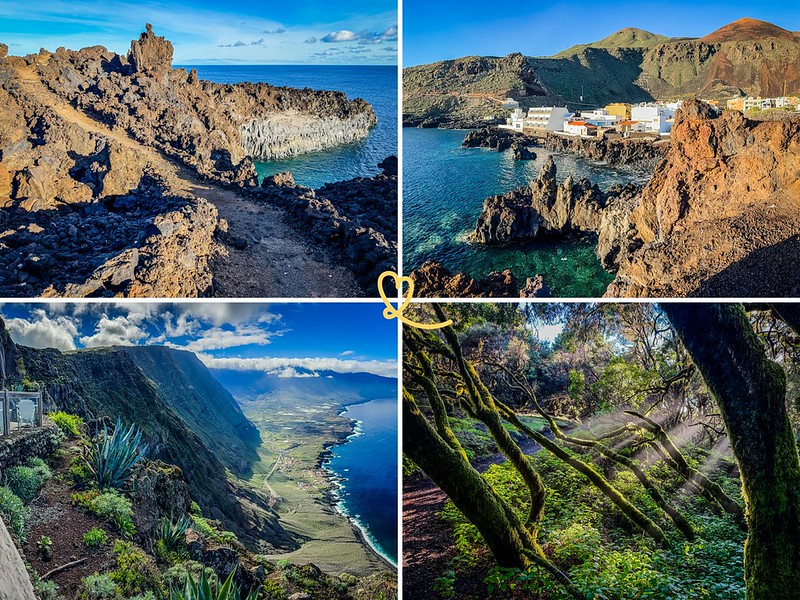
This opinion is completely independent, based on our experiences. We visited the region anonymously, making our own choices and paying our bills in full.
Visiting El Hierro in winter: is it worth it?
Our review
Visiting El Hierro in winter is a great idea. The island enjoys a mild climate all year round thanks to the trade winds, and the south often remains sunny even in the wet season. We enjoyed the island’s peaceful atmosphere during this period.
You can enjoy hiking trails, natural pools and viewpoints without queuing. The laurel forests gain in intensity in wet weather, and the clear evening skies offer remarkable starry nights.
We recommend this destination if you’re looking to reconnect with nature in a quiet, unspoilt setting.

Benefits
- The climate remains mild, especially on the island’s south coast.
- Crowds are low, so you can enjoy the sites in complete tranquillity.
- Accommodation rates are lower than in high season.
- The laurel forests, often shrouded in mist, reveal a unique atmosphere.
- Night skies are ideal for stargazing.
- Scuba diving is still possible in the La Restinga marine reserve.

Disadvantages
- Rain may affect the higher parts of the island, especially the north.
- The sea is sometimes rough, making some natural pools inaccessible.
- Days are shorter, limiting outdoor exploration time.
- Some services and restaurants operate reduced hours out of season.
- The water temperature is cooler for swimming.
- Low clouds can block the view from high vantage points.


Our 3 favorite places to stay in El Hierro:
- Las Puntas, for the scenery
- Tamaduste, for the scenery and pools
- Restinga, for the scenery and the diving
See the best-rated accommodations on the island
See our detailed comparison of the best places to stay on the island (with map and photos).
Weather, temperatures and conditions
El Hierro enjoys a subtropical oceanic climate tempered by trade winds. In winter, temperatures fluctuate between 15°C and 22°C during the day on the coast, while the higher parts of the island are cooler, around 10°C to 15°C.
Precipitation occurs mainly on the northern slopes and at high altitudes, where the laurel forests capture the clouds’ moisture. The south of the island, especially around La Restinga, is often sunny.
We advise you to bring layers of clothing, as the temperature differences between the coast and the peaks are considerable. A waterproof windbreaker comes in handy for forest hikes.
Also, check the sea conditions before visiting the natural pools: in case of swell, some become dangerous and access is not recommended.


There’s so much to discover: be sure to rent a car.
It’s not a very touristy island, so book early for the best choice.
What to do in El Hierro in winter
El Hierro is packed with natural and cultural sites to explore in winter. The island can be explored by car or on foot, between breathtaking viewpoints, natural pools carved out of lava, primary forests and quiet villages. Below is a selection of activities and places not to be missed. For a complete list, see our article: What to do in El Hierro.
Viewpoints: panoramic views of the island
El Hierro boasts several remarkable viewpoints. For exmepl:
The Mirador de La Peña, perched at an altitude of over 1,000m, overlooks the Gulf of El Golfo and its deep-green fertile plain. On a clear day, the silhouettes of La Palma and Tenerife can be seen on the horizon. The site houses a restaurant designed by Canary Islands architect César Manrique, a major figure in Canary Islands art and architecture, as well as a tea room with terrace. We were struck by the sheer scale of the panorama. It takes 15-20 minutes from Valverde; parking is available and the site is accessible to people with reduced mobility.

The Mirador de Las Playas overlooks the bay of Las Playas and Roque de la Bonanza from the air. The viewpoint is well laid out, surrounded by trees, and offers several viewpoints. We spent a long time there. About 20min from Valverde; free parking next to the lookout. Early mornings or late afternoons are best for low-angled light on the cliffs.

Natural pools: bathing in lava
One of El Hierro’s great attractions is its natural pools carved out of volcanic rock. In winter, swimming is still possible, but we strongly advise you to check the state of the sea before each outing. When the swell is high, the waves hit the basins directly and access becomes dangerous.
Charco Azul, in the El Golfo valley, is one of the island’s most popular bathing spots. This basin owes its name to the deep color of its waters, filtered by volcanic rock. We’ve observed that the place attracts both local families and travelers. The facilities are simple but sufficient: concrete steps and walkways lead to the pool. Some steep steps make access inadvisable for people with reduced mobility.

Other pools to discover include: Tamaduste and its well-sheltered natural lagoon, ideal for families; the natural pools of La Maceta, landscaped and easy to access; the lesser-known and wilder Charco de los Sargos, great for snorkeling; Charco Manso, on the north coast, aptly bears its name of “tranquil basin”, the pools of Tacoron, perfect for cooling off after a walk through the lava fields of La Restinga; and the pools of La Caleta, appreciated for their exposure to the sun.

Hiking and nature
El Hierro boasts over 600km of marked trails covering all levels of difficulty. In winter, forest walks are particularly atmospheric. La Llanía forest, in the heart of Frontera rural park, is a dense laurel forest whose ancient trees are twisted by the wind and often shrouded in mist.
This primary forest is part of an ecosystem that existed millions of years ago throughout the Mediterranean basin, before being confined to a few Macaronesian islands. We loved its unique atmosphere.
Nearby, the Hoya de Fireba volcano bears witness to the island’s geological activity. It’s a 30-40min drive from Valverde; the terrain is generally flat in the forest. Bring walking shoes, as the ground can be wet and slippery.

The La Maceta coastal hike on the northwest coast is one of the most accessible sections of the trail network. We loved this walk for the variety of landscapes it traverses: basalt cliffs, coves, rock formations and coastal vegetation adapted to the spray.
The signposted out-and-back route is around 5 to 6km, or 1h to 1h30 of leisurely walking. It’s an easy ride with very little change in altitude. You can combine the walk with a swim in La Maceta’s natural pools at the start or end of the route.

For walkers accustomed to steep climbs, the summit of Malpaso, the island’s highest point at 1501m, offers remarkable views over the whole of El Hierro on a clear day. The Valverde and La Frontera tourist offices provide detailed maps and hiking information sheets.
Geological sites and volcanoes
Roque de la Bonanza is one of El Hierro’s most photographed sites. This volcanic rock stands on the edge of the sea in the bay of Las Playas, facing a landscape of dark cliffs and calm waters. We were struck by the visual power of the place. The bay itself offers a peaceful setting. Allow 20-25min from Valverde; rocky terrain, closed shoes recommended.

The lava fields of La Restinga, at the southern tip of the island, bear witness to the underwater eruption of 2011. This mineral, almost lunar landscape contrasts strikingly with the intense blue of the Atlantic. We found this place fascinating for what it tells of El Hierro’s geological youth. The lava here is recent and still raw, and the rock formations retain unexpected shapes. Allow around 40-45min from Valverde; the terrain is uneven and the volcanic rock can be sharp – closed-toe shoes essential.

And many lava arches like theArco de las Mujeres at Las Puntas or theArco de la Tosca, at Punta de la Sal.

Diving and snorkeling at La Restinga
La Restinga marine reserve is recognized as one of Europe’s top diving destinations. Visibility is often exceptional, and the biodiversity impressive: nurse sharks, rays, moray eels, groupers and a dense invertebrate fauna. Several diving centers offer supervised outings from La Restinga, accessible to beginners and experienced divers alike.

Observing the stars
El Hierro is one of the least urbanized of the Canary Islands, making it an ideal location for stargazing. With few buildings, the night skies are crystal clear. We advise you to go out at night, especially from the heights of the island or the coastal areas away from the villages, to admire the celestial vault. In winter, nights are long and conditions are often favorable.

Villages, Museums and cultural heritage
You can also discover villages, museums and important sites that remain open and accessible in winter:
- TheEcomuseo de Guinea features a reconstructed ancient pre-Hispanic village and an eco-museum on the culture of the Bimbaches, the island’s first inhabitants.
- the Lagartario, a breeding center dedicated to the giant El Hierro lizard (Gallotia simonyi). This endemic species almost became extinct in the 20th century; some individuals can reach 60cm in length.
- At Ecomuseo, you can opt for a guided tour of a volcanic tube.
- The Museum of Volcanism, whose inauguration is linked to the underwater eruption of 2011, also retraces the geological history of El Hierro in a way that is accessible to all publics.
- The Garoé, a sacred tree in El Hierro’s collective memory

- The open-air museum in Mocanal, a small village in the north of the island, offers an original itinerary: informative panels along the way form a route for discovering the local heritage.
- Valverde, the island’s capital, is the only Canary Island capital not located by the sea. Perched at an altitude of over 570m, it offers a peaceful setting and architecture typical of Canarian villages.
- the artwork Homenaje a La Bajada, composed of giant figures
- The municipality of La Frontera has a rare architectural feature: its Nuestra Señora de la Candelaria church is separated from its belfry, the Campanario de Joapira, built in 1952 on an isolated volcanic rock.
- TheHermitage of Nuestra Señora de los Reyes, in the west of the island, is the most revered: it houses the patron saint of El Hierro and is at the heart of a traditional pilgrimage.
- Ermita San Pedro in Mocanal.

Driving in El Hierro in winter
Driving in El Hierro in winter is not particularly difficult.
We highly recommend renting a car to explore further.
El Hierro is an island that can also be understood along the way. Its secondary roads cross a wide variety of landscapes in just a few kilometers: laurel forests, high moors, lava fields, jagged coastlines. We recommend that you don’t plan everything and leave room for improvisation.
How do I get to El Hierro?
El Hierro has a small airport served by inter-island flights from Tenerife and Gran Canaria. You can also reach the island by ferry from Tenerife (port of Los Cristianos), a crossing that takes around 2h30.

Subscribe to our Newsletter
- Get away from it all with Region Lovers’ beautiful destinations!
- Once a month
- Advertising-free
Christmas in El Hierro
Spending Christmas in El Hierro means experiencing the festive season at a different pace. There are no big Christmas markets or light shows on the island like on the mainland, but the atmosphere is no less warm. Villages are adorned with modest decorations and residents gather for family celebrations.
We appreciated this sobriety, in keeping with the spirit of the island. Churches and hermitages host Christmas masses, and you can sample Canarian festive specialities in local restaurants. It’s an opportunity to discover another facet of island culture, far from the hustle and bustle of the big cities.
New Year’s Eve in El Hierro
Celebrating New Year’s Eve in El Hierro is a very special experience. As in the rest of Spain, tradition dictates that 12 grapes are eaten at the stroke of midnight for good luck in the New Year. Residents gather with family and friends to share the moment.
Some years a big party is held at the open-air theater next to the Campaniero, and almost the whole island turns out!
PLAN YOUR TRIP TO El Hierro
- Best of
Why visit El Hierro
Best attractions in El Hierro
Hiking (coming soon)
Arches (coming soon)
Natural pools (coming soon)

- Practical advice
How to get to El Hierro
Getting around (coming soon)
Rent a car and drive (coming soon)
When to visit (coming soon)
How long