
Not to worry. Here’s our complete guide to driving in El Hierro:
- Safety and driving difficulties
- Rules of conduct
- Road conditions
This opinion is completely independent, based on our experiences. We visited the region anonymously, making our own choices and paying our bills in full.
Driving in El Hierro: What you need to know
If you don’t want to read the whole article, at least read this short summary of the essential points to know:
- Minimum age 18, but some rental agencies may require drivers to be older.
- Driving on the right-hand side of the road.
- Seatbelts are compulsory for everyone.
- The legal blood alcohol level is 0.05%.
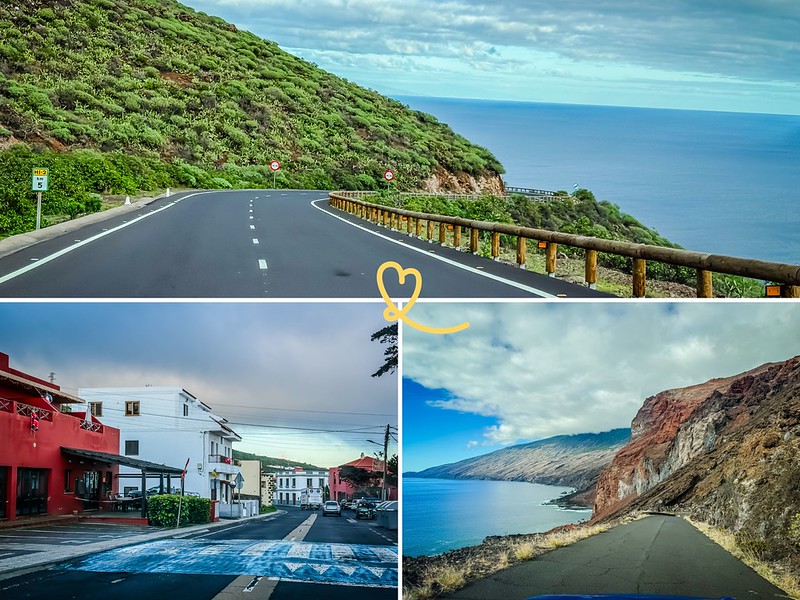
- Roads are generally in good condition, but mountain roads can be very winding and narrow.
- It is forbidden to wear flip-flops when driving (Spanish rule strictly enforced).
- Locals can be impatient: remember to check your rear-view mirrors for any vehicle wishing to overtake you.
- In case of accident – emergency number: 112
Here are the driving times to El Hierro, to give you an idea of how to get around:

1. Rent the right car in El Hierro
To make driving easier, it’s best to choose a vehicle adapted to local road types and conditions. We recommend El Hierro:
- Not too big, as many roads are narrow, especially in the north and interior of the island.
- A good engine, as some roads are very steep in mountainous areas
- Automatic if possible, as the roads are winding and require frequent gear changes
Find out more in our article on how to rent a car in El Hierro.
>> See car rental offers on our preferred platform

2. Know the rules of the road
Permit requirements
To drive in El Hierro, or in Spain, you need a valid driving license from your country.
If you are in possession of a valid driver’s license, which includes: license number, photo, validity date and written in Latin letters, then you do not need an international license.
Otherwise, you’ll need to bring along an international Driving License.
Age
You must be at least 18 years old to drive in El Hierro.
However, many rental companies apply their own conditions, often 21 years of age and a minimum of one year’s driving experience. Check your agency’s terms and conditions before booking.

General rules
- In El Hierro, we drive on the right-hand side of the road.
- Seat belts mandatory for all
- No cell phones while driving
- Headphones are forbidden
- Children under 12 are not allowed to sit in the front of the car.
- Don’t wear flip-flops when driving
Alcohol and driving
The legal blood alcohol limit in Spain is 0.05%. Driving under the influence is considered a serious offence and carries heavy fines.
We always recommend not drinking at all if you’re driving.
Mandatory in-car equipment
In El Hierro, the following equipment must be available in the car (as in the rest of Spain):
- 2 warning triangles
- Reflective vest or jacket
- Spare wheel and tools for changing it
- First-aid kit (recommended, not mandatory)
- Flashlight (recommended, not mandatory)
- Children weighing less than 18 kg must be placed in child seats.
- Children under 135 cm tall must be seated on a booster seat in the rear seats.

Compulsory insurance
The only compulsory insurance in El Hierro is unlimited liability insurance – automatically included in the price of all car rentals.
If you come with your own car, don’t forget to bring proof of insurance.

Our 3 favorite places to stay in El Hierro:
- Las Puntas, for the scenery
- Tamaduste, for the scenery and pools
- Restinga, for the scenery and the diving
See the best-rated accommodations on the island
See our detailed comparison of the best places to stay on the island (with map and photos).
3. Preparing for different types of road
Main roads
El Hierro has a network of main roads linking the island’s main areas, including the capital Valverde, to the rest of the territory. These roads are generally in good condition, with one lane in each direction.
We found the signage clear and the exits well indicated.
The HI-1 main road forms the central axis of the island. It links Valverde to the west and south, passing through the center. You’ll be on it most of the time.
This main road between Valverde and La Fontera passes through a long tunnel under the mountain.

There’s also a tunnel to access the magnificent Roque de Bonanza rock formation and Las Playas bay.
Access roads
It’s especially the last few kilometers to a location that can be more difficult: narrow, winding roads down to the parking lot. This is the case, among others:
- El Charco Manso
- Playa de Tacaron
- And the H500 road on the west coast
Take your time.

Mountain roads
At higher altitudes, there’s a mix of wide and narrow roads.
The biggest difficulty is the fog that sometimes falls.
To be honest, we only had a few once. For a few hundred metres in dense fog, we didn’t know what the roadside looked like.
But we drove the same route the next day without the fog, and there was really nothing to worry about…

In towns and villages
Valverde, the capital, is a small town with relatively quiet streets. You won’t encounter heavy traffic.
It’s really easy to drive in cities.
Some alleyways can be narrow, however.
El Hierro is the least populated of the Canary Islands, with around 11,000 inhabitants. Traffic remains limited throughout the region, including at peak times.

Unsealed roads
A few unpaved tracks exist in the most remote areas of the island, mainly to access protected natural areas. A standard vehicle will usually suffice, but check the condition of your rental car before setting out on these trails. To be on the safe side, check with your agency before taking any off-road trips.
4. Understanding signs and tolls
Speed limits
- Speed limits are indicated on circular signs with a red border and a black number.
- Speed limits are expressed in kilometers per hour
- 50 km/h in residential areas and built-up areas
- Up to 90 km/h on secondary roads outside built-up areas – always check the sign in force

Road signs
Road signs are in Latin letters and follow Spanish standards, so there’s nothing specific to learn. Directions to the main natural sites – such as the nearby Garajonay National Park, or the natural pools of La Maceta – are indicated on brown signs.

Tolls
There are no toll roads in El Hierro. All roads are free of charge.

It’s time to book your ferry crossings!
Compare everything: companies, prices, schedules and availability.
5. Safety: understanding potential hazards
Is driving in El Hierro dangerous?
No, on the whole, driving in El Hierro is not dangerous. Compared with the other Canary Islands, the island has very little traffic, which is a considerable advantage on mountain roads.
You’ll encounter a few challenges on the narrow, winding secondary roads, especially in the north-west. We advise you to adopt a moderate pace and to remain vigilant at blind junctions. On the whole, the island remains very accessible, even for drivers unaccustomed to mountain roads.

Potential hazards
- Landscapes –
The main risk is distraction. Views of the Atlantic Ocean and volcanic formations can capture your attention. Park your car at one of the viewpoints provided to make the most of the experience. - The premises –
As on the other Canary Islands, residents get around with their habits and can be impatient behind a hesitant driver. Keep an eye on your mirrors. - The fog –
Visibility is sometimes greatly reduced. But that’s what makes walks in primary forests so magical! - Animals –
Especially at dawn and dusk, animals such as goats and rabbits can cross the road unexpectedly. For once, we didn’t see any. - Rockfall –
Landslides are possible on some mountain sections. Signs indicate areas at risk. - Cyclists –
El Hierro attracts cyclists who are passionate about its gradients. Be careful when overtaking them, especially on bends.

Specific driving tips
On mountain roads, don’t be ashamed to drive slowly. El Hierro is an island where time flows differently. No one will judge you for that. Take your time, especially on hairpin bends.
If you pass a truck or bus on a narrow road, stop as close to the edge as possible and let it pass. These drivers know their vehicles and the island’s roads inside out.
In addition, some secondary roads have no guardrails on the empty side. We recommend that you keep a safe distance from the edge, especially in wet weather.

What to do in the event of an accident
If people are injured or there is a conflict, the emergency number is 112 (with multilingual operators).
The best order of action is:
- contact the emergency services
- contact the police
- contact your rental provider

There’s so much to discover: be sure to rent a car.
It’s not a very touristy island, so book early for the best choice.
6. And the rest: parking, fuel…
Fuels and service stations
- Fuel is considered cheap compared to the rest of Europe
- The Spanish word for service station is “estación de servicio”.
- Gasoline is found on the green pump – called “gasolina” and if unleaded “gasolina sin plomo”.
- Diesel is found on the black pump, called “gasoil”.
- Gas stations are few and far between on the island: fill up at Valverde or Frontera before setting off to explore the remote areas.
- El Hierro is a pioneer in renewable energies, but electric charging stations for passenger vehicles are still rare.

Parking in town
Parking is relatively easy in Valverde, La Frontera and LA Restinga. It’s a modest town, and doesn’t suffer from congestion. You’ll find plenty of street parking, even in the city center.

Parking at beaches and attractions
Around natural sites and beaches, parking lots are generally small and fill up quickly in high season. This is particularly true of Piscines Naturelles de La Maceta. We recommend arriving early to find a seat without difficulty.
El Hierro’s most beautiful roads
Frankly, the roads and landscapes were magnificent everywhere. It’s hard to single out the most beautiful stretches.
Some passages are more volcanic, with road rocks, while in other places, you’d think you were in New Zealand…

- The road to Roque de Bonanza and Las Playas Bay
- The road down to La Restinga in the south, through solidified lava flows
- Crossing the Frontera Rural Park, between laurisilve forest and panoramic views of El Golfo
- …

Frequently asked questions
Do you need a car in El Hierro?
Yes, without hesitation. El Hierro is an island whose treasures are scattered all over the territory, far from inhabited centers. Public transport is underdeveloped, making it difficult to reach natural sites. We believe that a car is absolutely essential to enjoy the island to the full.
If you want to limit yourself to Valverde and a few of the town’s restaurants, you may want to consider doing without. But that would be missing the point.
Is it necessary to rent a 4WD vehicle in El Hierro?
No. Main and secondary roads are paved and well-maintained.
PLAN YOUR TRIP TO El Hierro
- Best of
Why visit El Hierro
Best attractions in El Hierro
Hiking (coming soon)
Arches (coming soon)
Natural pools (coming soon)

- Practical advice
How to get to El Hierro
Getting around (coming soon)
Rent a car and drive (coming soon)
When to visit (coming soon)
How long