
Blond sand dunes, translucent beaches, thousand-year-old volcanoes… Fuerteventura is a generous island that makes you want to explore everything. Do you need a car to enjoy the benefits? We’ve tested both approaches, and have an honest answer: it can be done, provided you choose the right drop-off point and accept that some corners remain out of reach.
This guide gives you all our tips for visiting Fuerteventura without a car.
This opinion is completely independent, based on our experiences. We visited the region anonymously, making our own choices and paying our bills in full.
Car-free Fuerteventura: summary
- Yes, it’s possible, especially if your stay is focused on the beach and organized excursions.
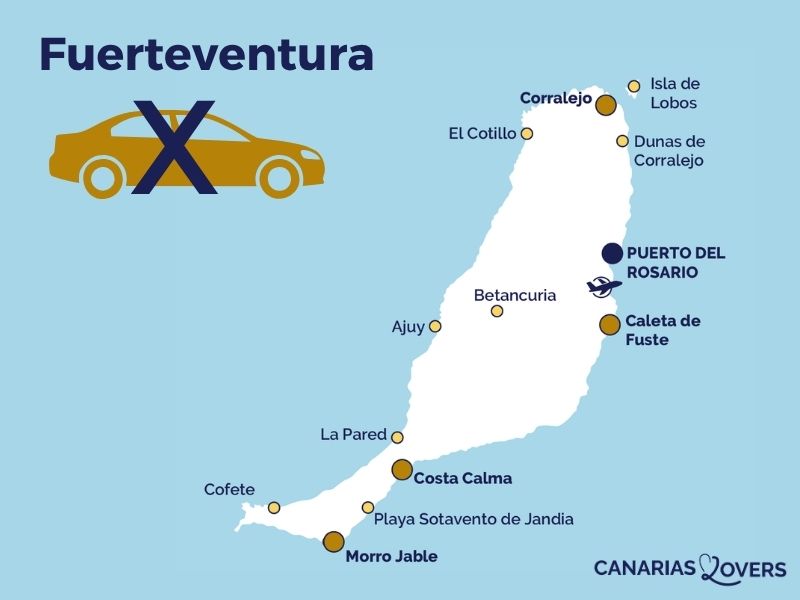
- The best car-free base in the north: Corralejo, for its compact old center, excursions and direct access to the island of Lobos.
- To the south, Morro Jable is the most convenient option, with its seafront promenade and dolphin excursion departures.
- The bus network is operated by Tiadhe: it links the towns well, but does not serve the emblematic natural sites.
- For Cofete, Betancuria or Ajuy, organized excursions are essential – see all options
- There is no Uber or VTC on the island, only cabs.
- Driving in Fuerteventura is very easy: wide roads, little traffic, moderate relief in tourist areas. Don’t let that stop you from exploring. All our tips here.

Can you really visit Fuerteventura without a car?
Yes, provided you calibrate your expectations. If your program revolves around the beach, a few organized excursions and evenings out in a lively old town, you won’t really need a personal vehicle.
On the other hand, Fuerteventura is a long island: between Corralejo in the north and Morro Jable in the south, allow 1h30 for the drive. Without cars, the bus network provides inter-city links, but leaves out isolated natural sites such as Cofete, La Pared or the mountain roads to Betancuria.

Where to stay without a car in Fuerteventura
Your choice of accommodation directly affects your level of autonomy. Some of the island’s towns are well connected, packed with activities and easy to get around on foot; others, often more authentic or quieter, will quickly leave you running out of options without a vehicle. Here are our three recommendations for a successful stay.
1. Corralejo: the best base in the north
- Old, compact center, ideal for doing everything on foot
- Direct ferry to Lobos Island from the port
- Nature Park dunes accessible on foot or by bike from the center
- Numerous organized excursions departing from the city
- Bus to Puerto del Rosario for connections to the rest of the island

Corralejo is, in our opinion, the most suitable town for car-free travel in Fuerteventura. Its old center is compact: you can walk to the beach, restaurants, shops and excursion agencies without ever getting on a bus. What’s more, the dunes of the Nature Park can be reached by bike directly from the center, a rare asset among the island’s resorts.
We particularly appreciate the variety of activities available without organization: swimming on the city beaches, ferrying to the island of Lobos, snorkeling, and evenings out in the narrow streets of the old town. For more remote sites such as Betancuria or Cofete, local agencies offer organized excursions departing from Corralejo, which cover most of the tourist program.
Find out more about Corralejo.
Our favorites: hotels in Corralejo
- Boutique hotel in the heart of the old town:
Hotel La Marquesina – See prices, photos and availability - East of the city, 5 stars:
Hotel Secrets Bahia Real, view of Lobos Island – See prices, photos and availability - For families:
Barcelo Corralejo Sands Hotel, all inclusive – See prices, photos and availability - See our selection of the best hotels in Corralejo
- See the best-rated available accommodations

2. Morro Jable: the best option in the south
- Several kilometers of beachfront promenade, all on foot
- Dolphin excursions depart directly from the marina
- Lively old town in the evening, restaurants and bars within walking distance
- 4WD excursions to Cofete departing from the city
- Cabs available for occasional trips

In the south of the island, Morro Jable is our benchmark for a car-free holiday. The town stretches out along the sea, but its seafront promenade makes it easy to walk to everything: the old town center, Playa del Matorral and restaurants. We were pleasantly surprised by the atmosphere of the old town in the evening, a far cry from the image of a characterless seaside resort.
What’s more, the dolphin-watching boats depart directly from the marina, so there’s no need to make any prior trips. One important point to note: if your hotel is on the north side of town, near the large Iberostar resorts, it’s a 25-30 minute walk to the old town. In this case, a cab or a rented bike can prove useful on a daily basis.
Find out more about Morro Jable.
Our favorites: hotels in Morro Jable
- Just above the beach, a boutique hotel:
Hotel XQ El Palacete, remarkable view – See prices, photos and availability - Grand resort, 5 stars:
Hotel Iberostar Palace, full service – See prices, photos and availability - For families:
Hotel Playa Gaviotas, entertainment for all ages – See prices, photos and availability - See our selection of the best hotels in Morro Jable
- See the best-rated available accommodations

3. Caleta de Fuste: a central location for families
- Just minutes from the airport: no long transfers on arrival
- Gently sloping beach, ideal for young children
- Direct bus service to Puerto del Rosario and connections to the entire Tiadhe network
- Organized excursions from hotels

Caleta de Fuste doesn’t have the charm of Corralejo or the extensive beaches of Morro Jable, but it does offer two solid assets for car-free travelers. Firstly, its immediate proximity to the airport immediately eliminates the expense and logistics of the first transfer. Secondly, its central location on the east coast makes it easy to get to other cities.
We especially recommend it for families with small children: the shallow, wave-free Playa del Castillo is ideal for a leisurely swim. The large excursion agencies present in the hotels make it possible to program Betancuria, the caves or a sea outing without worrying about transport.
Let’s be honest about one limitation: Caleta is almost exclusively a tourist town, with little soul outside the hotel complexes. We recommend adding a half-day in Puerto del Rosario to compensate.
Find out more about Caleta de Fuste.
Our favorites: hotels in Caleta de Fuste
- For families:
Barcelo Royal Family Hotel, swimming pool and kids club – See prices, photos and availability - For golf enthusiasts, 5 stars:
Hotel Elba Palace Golf, upscale resort – See prices, photos and availability - See all our selection of the best hotels in Caleta de Fuste
- See the best-rated available accommodations

Places to avoid if you don’t have a car
- La Pared: small, isolated village on the west coast, with no bus service. The cliff scenery is breathtaking, but the village is too remote to make it a base. To be booked for an excursion.
- Betancuria: the island’s former capital is nestled in the mountains, on winding roads that are impossible to access by public transport. A beautiful village, but only on organized tours or with a rental car.
- El Cotillo: an authentic and attractive northern village, best known for its lagoon beaches. Please note: bus connections from Puerto del Rosario are limited and very infrequent. Seductive for a night or two if you accept few outings.

Getting to your accommodation from the airport without a car
Fuerteventura Airport (FUE) is located near Puerto del Rosario, on the island’s central east coast. From the moment you arrive, there are a number of options available to you without the need for a rental car.
Bus option
The Tiadhe airline serves the airport: direct flights link the terminal to Puerto del Rosario and Caleta de Fuste. From Puerto del Rosario, there are connections to Corralejo to the north and Morro Jable to the south. Fares range from 2 to 10 euros, depending on destination. The main drawback: buses don’t drop off in front of hotels, and frequency can be low depending on your flight schedule.
Cab option
Cabs are available directly from arrivals. We recommend this option for late arrivals or if you’re traveling in a group. Expect to pay between 15 and 25 euros for Caleta de Fuste, around 30 to 40 euros for Corralejo or Costa Calma, and up to 60 euros for Morro Jable.
Private transfer option
A pre-booked transfer is the most comfortable solution: you are picked up at the exit and dropped off directly at your hotel.

Getting around: bus, bike, walking, excursions
Once you’ve settled in, there are plenty of ways to explore the island. Each corresponds to a different type of outing: buses for the cities, excursions for natural sites, cycling and walking for the immediate surroundings. Here’s the full rundown.
Organized excursions
For Fuerteventura’s most striking natural sites, organized excursions are often the only viable alternative without a car, and they have the advantage of including a guide to enrich each visit. We particularly recommend them for Cofete, Betancuria and the Ajuy caves, otherwise inaccessible from the seaside resorts. Most agencies offer pick-ups from Corralejo, Morro Jable and Caleta de Fuste. Booking in advance on GetYourGuide is advisable in high season to secure your place.
Among our favorite excursions:
- Panoramic tour of the island (dunes, mountains, Betancuria): see program and availability
- Dolphin watching from Morro Jable: see program and availability
- 4WD excursion to the wild coast of Cofete: see program and availability
- Round-trip ferry to Lobos Island from Corralejo: see program and availability
See our complete selection of the best excursions in Fuerteventura.

Bus network
The Tiadhe network links all Fuerteventura’s main towns, usually with Puerto del Rosario as the central hub. Fares are very affordable, between 2 and 10 euros depending on the route. We found the bus convenient for inter-city travel (Corralejo, Morro Jable, Caleta de Fuste), but limited for tourist sites: it doesn’t serve Cofete, the west coast trails or the mountain roads.
What’s more, some lines have only a few passages a day, making it difficult to link up several sites in the same day. Visit the official website for more info.

Getting around by bike
Fuerteventura is a pleasant destination for cycling: the roads are well-maintained, traffic is generally calm in the tourist areas and there is little relief around Corralejo or Morro Jable. The climate allows you to cycle all year round, even if the island offers little shade, making early morning rides essential in summer.
We recommend electric bikes for longer distances or busy days. Rental companies are present in the three main towns, making day-to-day organization easy.
Getting around on foot
The old centers of Corralejo and Morro Jable are easily accessible on foot. Both towns have coastal promenades that link beaches, restaurants and shops without the need for a car. Corralejo, with its particularly compact center, is undoubtedly the easiest to explore on foot.
We do, however, recommend that you avoid the main roads that link the towns together: the verges are often non-existent or made of volcanic rock, with no sidewalks.

Cabs and VTC: when and how to use them
There are no Uber or VTC services in Fuerteventura. Cabs are available in all the main resorts, and fares are reasonable for short distances. They’re a useful solution for occasional outings: to a beach that’s a little far away, to get home late at night, or to a nearby town.
Some drivers also offer day tours, an intermediate format between a guided excursion and car rental. We advise you to agree the price in advance for this type of service. The main company is Taxis Fuerteventura.
Going to the Corralejo Dunes without a car
The Corralejo Dunes Natural Park is one of Fuerteventura’s most emblematic images: kilometers of clear sand dunes merging into a turquoise sea, facing the island of Lobos. It’s also one of the island’s few major natural sites accessible without a car, making it a godsend for travelers choosing to stay in Corralejo.
From the town center, the dunes can be reached on foot in around twenty minutes, or by bike in less than ten. You can also take a cab for a few euros if you wish to reach the more remote areas of the park to the south. We recommend setting off in the morning, before the sun is at its zenith: the almost total absence of shade on volcanic terrain makes mid-day outings difficult to bear in summer.
If you’re staying elsewhere, island tours often include a stop at the dunes. See options.
Find out more in our guide to Corralejo Dunes Natural Park
Getting to Lobos Island without a car
The island of Lobos is one of our favorite destinations on Fuerteventura, and it has the particularity of being naturally adapted to travelers without a car: there are no paved roads on this small, uninhabited island, and everything can be done on foot. To get there, a ferry leaves regularly from the port of Corralejo, taking 15 minutes.
We were struck by the uniqueness of the landscapes: cones of volcanic rock emerge from a lunar soil, La Calera beach offers a transparent swim at the foot of a volcano, and a walk around the island reveals a feeding lagoon for migratory birds. You can also climb up to the lighthouse for a breathtaking panorama of the whole island. A full day is just the thing to make the most of it.
How to get there without a car: ferry from the port of Corralejo – book your round-trip ferry
Find out more in our Lobos Island guide.

Getting to Cofete without a car
Cofete is Fuerteventura’s most impressive and difficult-to-reach location. This wild coastline, on the western side of the Jandía peninsula, can only be reached by a long unpaved track, which is not recommended for standard rental cars, whose insurance generally does not cover this type of terrain.
Without a car, the organized 4WD excursion is the only realistic option, and we don’t consider it a constraint: the guides tell the story of this unspoilt coast, and the arrival in convoy on the heights overlooking the beach is in itself striking. We were amazed by the sheer size of the cliffs and the power of the waves crashing against them. It’s a landscape that’s hard to describe, and one that you have to see at least once.
4WD excursion to Cofete from the south of the island: see program and availability

Other sites accessible on foot, by bike or by bus
In addition to the three sites presented above, Fuerteventura offers other destinations that can be reached without a personal vehicle, provided you choose the right means of transport or take an excursion.
Ajuy caves
Ajuy is a small fishing village on the west coast, whose cliffs conceal giant sea caves carved out of rock millions of years old. The tour begins on a black sandy beach, then follows the cliff to the entrance of the caves. We found this place fascinating for geology enthusiasts: the rock formations are remarkably precise and the strata of the ancient seabed are still visible to the naked eye.
Access from the seaside resorts is by organized excursion or, for travelers staying at Caleta de Fuste, by cab for a journey of around twenty kilometers.
Various tours of Fuerteventura include a visit to these caves: see options
Find out more in our guide to the Ajuy caves.

Betancuria
Founded in 1404 by Jean de Béthencourt, Betancuria was the island’s first capital and retains its historic charm intact: white streets, palaces with brown brick facades and the church of Santa Maria, rebuilt in the 17th century. The village is nestled in the central mountains, on winding roads with no regular bus service.
The only way to get there without a car is an organized excursion, usually coupled with a panoramic tour of the island, including the mountain viewpoints. We reckon it’s well worth the detour: the scenery of eroded volcanoes along the way is among the most beautiful on Fuerteventura.
How to get there without a car: panoramic tour of the island from Corralejo or Morro Jable – see program and availability
Find out more about Betancuria.

Plan a car-free itinerary
The main pitfall to avoid is trying to cover too much distance. Without a car, every trip takes more time and planning, organized excursions take up entire days and bus connections can quickly complicate an ambitious program. We advise you to adopt a slow-travel approach: one major excursion per day, a site accessible by bus or on foot on other days, and half-days dedicated to local beaches. This makes your stay more relaxing and, often, more memorable.
A few logical groupings to optimize your days:
- North day: Corralejo dunes on foot in the morning + Lobos island by ferry in the afternoon (from Corralejo)
- Mountain day: panoramic tour (Betancuria + miradors + volcano views)
- Day at sea: dolphin watching by boat from Morro Jable
- Wild Coast Day: 4WD excursion to Cofete (from the south)
- Free days: Puerto del Rosario by bus, local beaches on foot or by bike

Frequently asked questions
Car-free Fuerteventura for the beaches
If your priority is the beach, Corralejo is our first choice: the town beaches are just a stone’s throw from the center, the dunes of the Natural Park are accessible by bike and the island of Lobos, a short ferry ride away, offers a beach of absolute calm.
For families looking for shallow, wave-free water, Caleta de Fuste is a solid alternative. Morro Jable, meanwhile, is ideal for lovers of long sandy beaches, with Playa del Matorral stretching for several kilometers.
See Fuerteventura’s most beautiful beaches.
Car-free Fuerteventura with children
With young children, Caleta de Fuste is the most suitable base: the gently sloping beach makes for safe swimming, the larger hotels have kids’ clubs and organized excursions leave directly from the residences.
Corralejo is also an excellent choice for families, with access to the island’s only water park (Acua Water Park), boat trips to Lobos and a variety of beaches. Teenagers will appreciate the lively atmosphere of Corralejo more than the quieter Caleta.
PLAN YOUR TRIP TO Fuerteventura

- Practical advice
25 tips for a successful trip to Fuerteventura
How to get around
How to rent a car in Fuerteventura
Driving tips
Best excursions
Itineraries: 3 days – 4 days – 5 days – 1 week – 10 days